

Hanoi Train Street: The Complete Visitor’s Guide
Imagine sitting just a few feet away from a passing train while sipping a hot cup of Vietnamese egg coffee – that is the magic of Hanoi Train Street. This extraordinary hanoi railway street, where an active railway track hanoi slices straight through a tightly-packed residential neighborhood, draws thousands of curious travelers every year. What began as an everyday commuter corridor has quietly become one of the most iconic travel experiences in all of Southeast Asia. In this guide, My Vietnam Tours will show you everything you need to know about Hanoi Train Street when traveling there.
1. The Story Behind Hanoi Train Street
The origins of this legendary hanoi railway street trace back to 1902, during the French colonial period, when engineers laid railway tracks through the heart of the city to connect Hanoi with the port city of Hai Phong. Over the following decades, entire communities of railway workers and their families built their homes alongside the tracks – sometimes leaving only centimeters between their front doors and the passing carriages.
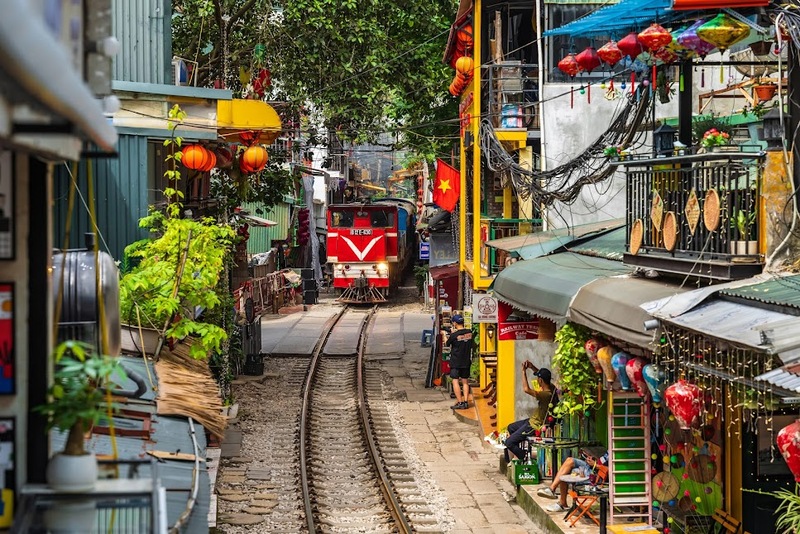
The railway track hanoi survived the devastating bombing campaigns of the Vietnam War, though the surrounding homes suffered serious damage. Resilient residents rebuilt their houses piece by piece, and the unique community that grew up along the tracks continued to thrive. Today, what once existed purely out of practical necessity has been transformed into one of the most photographed locations in Vietnam.
The global spotlight found Hanoi Train Street largely through social media. When travel bloggers and photographers began sharing images of trains threading impossibly close to café tables and kitchen windows, the world took notice. What captivates visitors is not just the spectacle – it is the unfiltered glimpse into the everyday rhythm of Hanoian life.
2. Where Is Hanoi Train Street and How to Get There
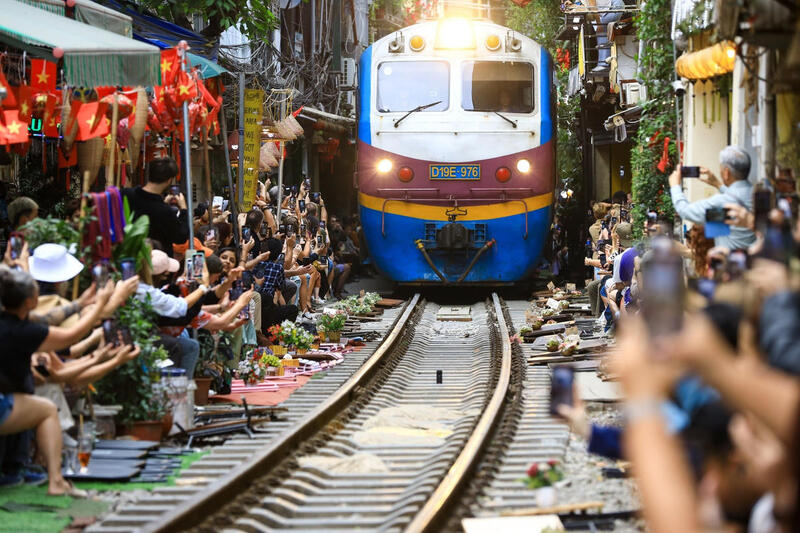
The Hanoi train street spans several sections of the city, running through Phung Hung, Dien Bien Phu, and Le Duan streets. For most visitors, the two best starting points are Alley 224 on Le Duan Street or Alley 5 on Tran Phu Street. The stretch along Phung Hung Street is considered the most vibrant and lively, offering the densest collection of cafés and street stalls.
Getting There: Your Best Options
By Taxi or Grab – The quickest and most comfortable option. A ride from Hanoi’s Old Quarter costs between 50,000 and 100,000 VND and drops you directly at the alley entrances on Le Duan or Tran Phu streets.
On Foot – Guests staying in the Old Quarter can walk to the Le Duan section in roughly 15 minutes. The stroll itself passes through charming streets, making it a rewarding journey in its own right.
By Public Bus – Routes 19, 36, 38, and 39 all stop near the Phung Hung stretch of the Hanoi train street. The fare is just 8,000–12,000 VND per trip – an excellent budget option.
By Motorbike or Bicycle – Renting a motorbike or bicycle gives you the freedom to explore at your own pace. Daily rentals range from 30,000 to 200,000 VND, and many cafés offer parking for around 10,000 VND.
Tip: The Le Duan entrance (Alley 224) is quieter and often preferred by travelers who want a more relaxed experience. Phung Hung is livelier and better suited for those who enjoy a buzzing atmosphere.
3. Train Schedule at Hanoi Train Street
Timing your visit around an actual train pass is central to the experience. The railway track hanoi carries several daily services, and the schedule varies by section of track.
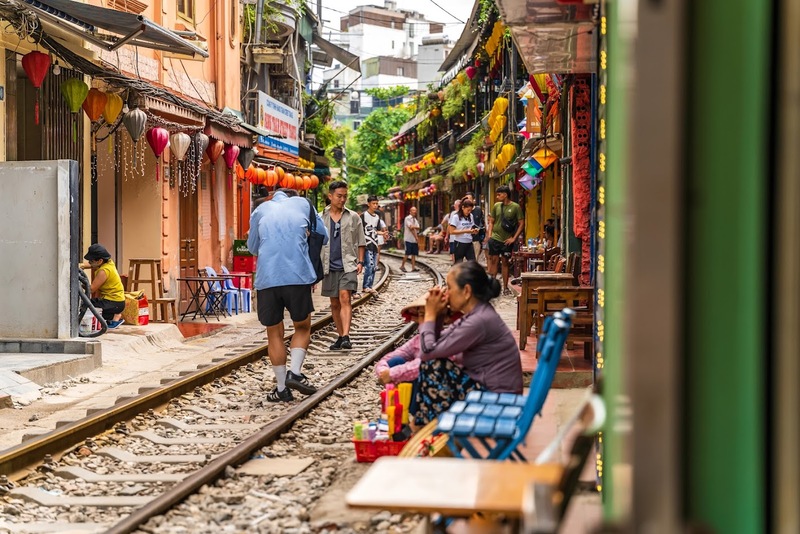
On Le Duan Street, trains run daily at approximately 6:10 AM, 11:40 AM, 3:30 PM, 6:00 PM, 7:10 PM, 7:50 PM, and 9:00 PM.
On Phung Hung Street, trains pass Monday through Friday at around 8:30 AM, 9:30 AM, 11:50 AM, 3:15 PM, 7:50 PM, 9:15 PM, 9:30 PM, and 10:00 PM. On weekends, additional services run from 6:00 AM through the evening, making Saturday and Sunday the best days for catching multiple trains.
Important: Schedules are subject to change without notice. Arriving 30 minutes early and consulting café staff – who always know the latest information – is strongly recommended. Delays are common, so plan to stay a while and enjoy the atmosphere while you wait.
4. Top Experiences at Hanoi Train Street
4.1. Sip Coffee Right by the Tracks
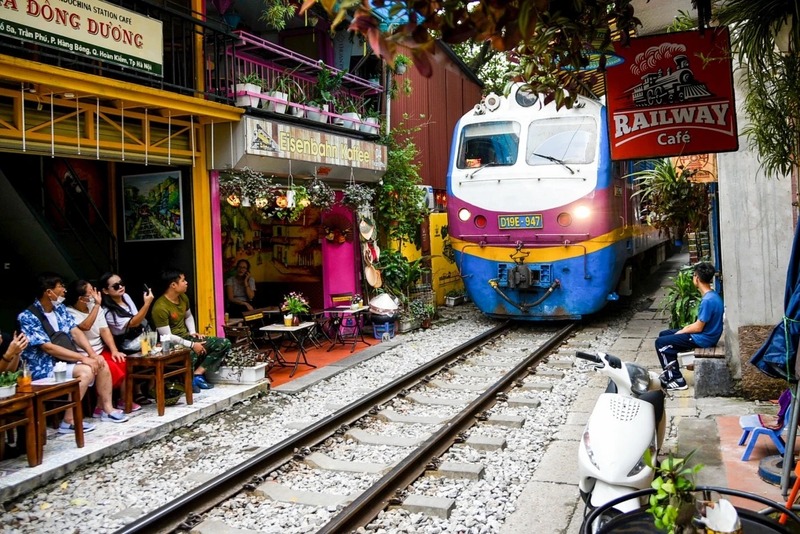
No visit to the hanoi railway street is complete without settling into one of the trackside cafés and ordering a Vietnamese coffee. Aromatic drip coffee (cà phê phin) and creamy egg coffee (cà phê trứng) are the local favorites, with prices ranging from 25,000 to 60,000 VND per cup. As the train approaches, café owners signal guests to move slightly aside – then, moments later, the train thunders past just an arm’s reach away.
Some well-regarded cafés along the Phung Hung stretch include 30 Train Coffee (30 Duong Tau), San Ga 62 (62 Duong Tau), MER Café (48 Duong Tau), and Hao Hao Coffee (80 Chan 5, Tran Phu). Several cafés also open their upper floors, offering an elevated vantage point for photography.
Tip: Arrive at least 30 minutes before a scheduled train pass to secure a good seat and order your coffee without rushing.
4.2. Explore the Mural Art of Phung Hung
Running beneath the Long Bien Bridge overpass along Phung Hung Street, a remarkable stretch of community murals brings the history of old Hanoi to life. Local artists have depicted scenes of Hanoi’s legendary tram network (which operated from 1901 to 1991), traditional markets, street vendors, festivals, and historic architecture – all in vivid, saturated colors.
These murals transform what might otherwise be a concrete underpass into an open-air gallery. They offer a thoughtful counterpoint to the raw energy of the railway track hanoi, inviting visitors to slow down and reflect on the city’s layered past.
Tip: Visit on a clear morning for the best light. During holidays such as the Lunar New Year and Mid-Autumn Festival, the street is adorned with lanterns and flags that add another layer of photographic magic.
4.3. Watch the Train Pass – the Main Event
Standing safely at the edge of an approved café area as a train barrels through the narrow Hanoi train street corridor is genuinely exhilarating. The rumble builds, locals step back from their stoops, a vendor quickly lifts a basket off the ground – and then it is over in seconds, leaving behind only a rush of wind and the lingering sound of the horn. Most visitors find themselves wanting to stay for multiple passes.
Tip: A wide-angle lens captures both the approaching train and the full depth of the narrow alley in a single frame. For action shots, position yourself at a curve in the track where the train comes into view dramatically.
4.4. Sample Street Food Along the Tracks
The culinary scene around the hanoi railway street is every bit as rewarding as the trains themselves. The scent of simmering pho broth drifts from small shops, while grills emit fragrant smoke from skewers of marinated meat. A hot bowl of beef pho costs as little as 40,000 VND, while more substantial grilled dishes run up to around 325,000 VND.
Notable eateries near the Phung Hung section include:
- Mien – Banh da cua (crab noodle soup), 6a Phung Hung – open 7:30 AM to 10:00 PM
- Pho Bo Duc Khoi, 77 Phung Hung – open 6:30 AM to 10:00 PM
- Cha Ca Ngon (grilled fish cake), 115B Phung Hung – open 9:30 AM–2:00 PM and 5:00–10:00 PM
4.5. Connect with Local Residents
One of the most quietly moving aspects of visiting Hanoi train street is witnessing how the community goes about daily life with complete composure – children kicking a ball between the rails, elders playing checkers on plastic stools, a grandmother calling her dog in from the tracks. Chatting with locals, even briefly, often leads to warm exchanges and genuine insight into what it means to grow up alongside a working railway.
During local holidays, the street hosts cultural performances and community gatherings that welcome curious visitors.
4.6. Browse Trackside Souvenirs
Small shops lining both sides of the alley sell a range of traditional Vietnamese handicrafts – hand-painted railway scene artwork, lacquerware, embroidered wallets, silk items, and ceramic teapots. These make meaningful keepsakes that connect directly to the unique character of this place. A friendly bit of negotiation is welcome and expected.
5. Safety Guidelines for Visiting Hanoi Train Street
The Hanoi train street is safe to visit when visitors respect both the railway and the residential community. The following guidelines are essential:
- Always follow instructions from railway staff and café owners – they know the schedule and signal when to step back.
- Never stand on or near the railway track hanoi when a train is approaching. Move to the designated safe zones promptly.
- Do not place cameras, tripods, or bags on the tracks; this is both dangerous and inconsiderate to residents.
- Keep children closely supervised at all times. The tracks are active and trains approach quickly.
- Drone use is prohibited without official permission.
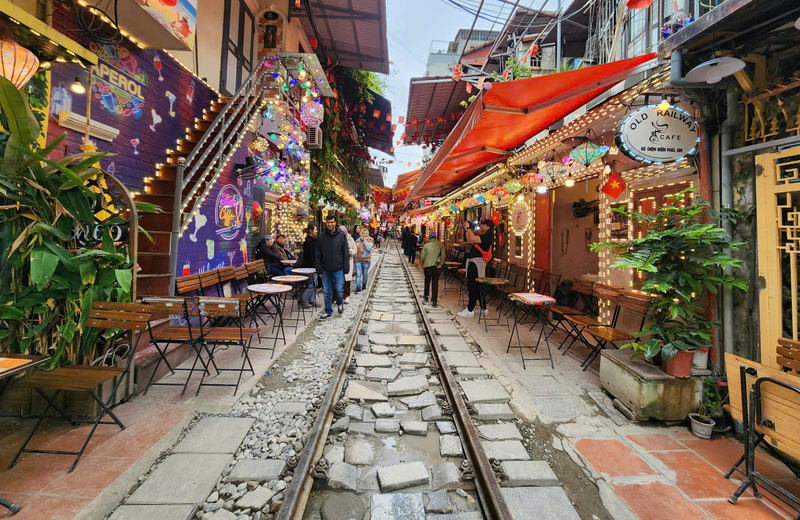
In 2019, Vietnamese authorities temporarily closed the most popular section of the hanoi railway street following a series of near-miss incidents caused by tourists standing too close to oncoming trains. The area has since reopened, but ongoing access depends on visitors behaving responsibly. Exploring with a reputable local guide is an excellent way to enjoy the experience fully while staying safe.
Hanoi Train Street is unlike any other travel experience in Vietnam. It is a place where the past and present coexist in literal centimeters, where a working railway track hanoi runs through a living, breathing community that has adapted with extraordinary grace. Whether you come for the coffee, the photography, the street food, or simply the sheer spectacle of a train threading through a residential alley, this hanoi railway street will stay with you long after your trip has ended.